Showing posts with label Budget Control Act. Show all posts

Thursday, April 12, 2012

Education

My last post "Supreme Court on the Health Care Reform Law & the Ryan (Republican) Budget" was posted and distributed on April 6th. In that post I explained that my discussion entitled “It’s All About Race” would have to be postponed and now I feel I must do so again, but his time indefinitely. However, I will address this complex and difficult subject in due course.

Now to revert to my post as set forth above, Ernest Hauser of the Bronx, NY called my attention to an error. I stated that the Budget Control Act of 2011 was passed in the Senate by a vote of 74 to 26 with 55 Republicans voting for it. Hauser pointed out that this was impossible since there are only 47 Republicans in the Senate. I should have said “with 28 Republicans voting for it.” Sorry for the error.

I also made a misstatement when I said it has not been reviewed by the CBO. This assertion was made after a long and fruitless search for a CBO analysis caused me to conclude that it did not exist. However, in a NewYorker article by James Surowiecki there is a reference to a CBO analysis. Therefore I stand corrected. Mea culpa!

On the other hand Albert Nekimken PhD of Vienna, Virginia and the author of four books complimented me with this:

Well done, as usual. I haven't had time to follow up all of your links included here, but thanks for doing such meticulous work in documenting the ongoing, attempted Republican takeover of our governmental institutions. It's a sad read.

What prompted me to address the subject of education was an insightful article that was posted on the blog of one of my subscribers, Roger Berkley of Woodcliff Lake, NJ, President and CEO of Weave Corporation and past President of the National Textile association. His article is a must read and can be found here.

It was that article that prompted me to respond to it as follows:

You are right that Santorum as an individual is no longer relevant, but as a philosophy, and as one who undoubtedly speaks for millions, he is very relevant.
                       
It is interesting to note that Santorum knocks education for others, while he himself has a BA an MBA and a JD. How hypocritical for a man who has spent so much time, money and effort gaining an education. Talk about elitism. It’s good for him, but not for those adoring followers of his, who in his view, don't need, and shouldn't want the benefits that an education has bestowed on him. Why can't they see what contempt that shows?
                       
Whether it is Santorum or Romney or Ryan - none of them are interested in making education available to the broad population. They want it to be for an elite group like themselves, who will rule over us and tell us that it isn't about achieving equality, that it is about opportunity. But here they are up to their usual tricks. They resort to the old reliable straw man. As though anyone of any consequence wants to impose equality. Opportunity is precisely what it is all about. And that is precisely what they want to deny the bulk of our citizenry.

Many years ago I read Hitler's Mein Kamf. What struck me, and what I will always remember is that Hitler considered the USA a formidable and dangerous foe because he said the educational system of the US comprises all, regardless of class, while Europe was stuck in a class warp. 
                       
To quote from Wikipedia
                                   
"By 1900 educators argued that the post-literacy schooling of the masses at the secondary and higher levels, would improve citizenship, develop higher-order traits, and produce the managerial and professional leadership needed for rapid economic modernization. The commitment to expanded education past age 14 set the U.S. apart from Europe for much of the 20th century. From 1910 to 1940, high schools grew in number and size, reaching out to a broader clientele. In 1910, for example, 9% of Americans had a high school diploma; in 1935, the rate was 40%. By 1940, the number had increased to 50%. This phenomenon was uniquely American; no other nation attempted such widespread coverage. The fastest growth came in states with greater wealth, more homogeneity of wealth, and less manufacturing activity than others. The high schools provided necessary skill sets for youth planning to teach school, and essential skills for those planning careers in white collar work and some high-paying blue collar jobs. Economist Claudia Goldin argues this rapid growth was facilitated by public funding, openness, gender neutrality, local (and also state) control, separation of church and state, and an academic curriculum. The wealthiest European nations such as Germany and Britain had far more exclusivity to their education system and few youth attended past age 14. Apart from technical training schools, European secondary schooling was dominated by children of the wealthy and the social elites. The United States chose a type of post-elementary schooling consistent with its particular features — stressing flexible, general and widely applicable skills that were not tied to particular occupations and geographic places had great value in giving students options in their lives. Skills had to survive transport across firms, industries, occupations, and geography in the dynamic American economy."
                       
I am a refugee from Hitler's Holocaust in Vienna, Austria. Even in Vienna my father was a struggling haberdasher. When we came to the US, he took a job as a bottle washer. Eventually, with the help of relatives he advanced to being a technician in quality control, but he never made much money. My brother never overcame these handicaps, became a high-school dropout and eventually a post office mail handler. I was more ambitious. I wanted to go to college. I could not have done so, (and eventually go to law school) if there had not been a free college available close to home. CCNY of CUNY allowed me to live at home, commute by subway for a nickel, and attend college tuition free. This allowed me to save the money I earned working summers, which I could set aside for graduate school. That is over with. There are no free colleges.
                       
How far we have regressed! And they want us to regress still further!
                       
If we are to remain a great nation it will not be by the strength of our military, though we need that too, but by the strength of our educational system. It is time for every state and every city and county, to have a free college system and that will only happen if it is financed at the federal level. Just as between 1910 and 1040 we moved to make high school within the reach of everyone, so we now need to make college within the reach of all. Only in this way will we make this a land of opportunity again, close the income gap, and assure the greatness of our nation in the 21st century. Those who say we cannot afford this are giving up on the future of America, and dooming, not only an underclass to remain an underclass, but are pushing millions who had achieved middle class status in another age, out of the middle class.
                       
Not only will the middle and lower classes benefit from such an approach, but in the long run, so will those at the top. 
                       
It is true that what we want is a larger pie for all, but that will not be achieved, by lower and lower taxes, particularly on the rich, but by evaluating the needs of our nation and then raising the right amount of money to meet those needs.
                       
We must realize that we cannot go on deciding how little we will tax, and then focus on what we can afford. We need to decide on what this nation's needs are, what it will cost to meet those needs, and then focus on what level of taxation is required, to meet those needs. In 1986, during Reagan's second term, our marginal tax rate was 50%. By the time he left office the rate was 28%. At the end of the prosperous Clinton era it was 39.6%. The Ryan plan would reduce that to 20% and raise additional revenues by unspecified (the rabbit in the hat - now you see it now you don't) elimination of tax expenditures. This is a formula that makes nothing possible. It is a formula for an ever-greater divide between the super rich and the rest, and the decline of our nation.

On another note I must call the readers attention to the stepped up War on Women, at least in Wisconsin. See here.

Comments, questions, or corrections, are welcome and will be responded to and distributed with attribution, unless the writer requests that he/she not be identified.

Friday, March 09, 2012

Social Security – An Honest Evaluation

In my last post entitled "The Truth is a Sometime Thing? (Discussion)" I moved from a focus of misinformation, resulting from outright lies in many cases, on the part of the Right, to the misleading, destructive and naïve opposition to all changes in the benefits provided under Social Security, Medicare and Medicaid. Yet the three programs are financed so differently from each other, have such different benefit programs, and have such different financing problems, that a discussion of the three does not lend itself to clarity.

Instead let me start by defining the three programs. Social Security is often thought of as a retirement program that only benefits those over 67. It is in fact a program that covers a large group of benefits, but for purposes of our discussion we need to focus on what is the main part of the program that is often referred to under the acronym OASDI, which stands for Old Age, Survivors, and Disability Insurance or RSDI, which stands for Retirement, Survivors, and Disability Insurance.

It is this program that I want to address today.

First some background. The Social Security Trust Fund has not been stolen for other purposes. It is intact and is invested in government securities, the safest in the world. The confusion about the fund derives from the fact that during the Johnson Administration (1968) the “unified budget” was enacted. The official purpose of the Act “was an effort to rationalize what the Commission viewed as a confusing budget presentation.” I have always thought, and continue to think that it was intended to hide the huge deficits that Johnson was incurring in simultaneously fighting the Vietnam war and pursuing the “Great Society”. At that time the Social Security Trust fund was running very substantial surpluses, and so including the Trust fund as part of the unified budget masked the size of the deficit. However, in 2010 expenditures, for the first time, exceeded income from the payroll tax, and will do so hereafter. See here

Nevertheless, the combined trust funds will continue to grow because projected interest earnings of $115 billion substantially exceed the non-interest income deficit. Beginning in 2023, however, net redemptions of trust fund assets with General Fund payments will be required, until its assets are exhausted in 2036. After trust fund exhaustion, continuing tax income will be sufficient to pay 77 percent of scheduled benefits in 2036 and 74 percent in 2085. Ibid.

But that means that even without any changes full payments of Social Security benefits would be paid to all those who are now 44 years old or older, which is better than the guarantee offered by the Ryan budget by one year, and unlike the Ryan budget benefits at a reduced rate would continue to be paid.

However I don’t believe that is good enough. We need to make sufficient changes so that people who are now 24 years old and are paying into the trust fund for the benefit of older generations are guaranteed full benefits. If we don’t do that, these younger generations will see little reason to support the system, and it will be doomed much earlier, simply because young people will insist that they not pay into a system from which they will not draw the full benefits of older generations.

What should we do?

Gail Collins writing in the New York Times posits:

The basic answer to fixing the long-term Social Security imbalance is just to eliminate the payroll tax cap, which currently exempts all income over $110,100 a year. Do that, and you have solved the problem. Politically speaking, you would probably have to agree to mix a limited tax increase with one of the fixes desired by fiscal conservatives, like reducing benefits for the wealthy, or changing the cost-of-living adjustment or, yeah, raising the retirement age a little. But the main answer is that cap, and anybody who refuses to even discuss the payroll tax cap is not serious about fixing Social Security.

She is right in every respect except one crucial one: Republicans are not serious about fixing Social Security. They are committed on the one hand to abolishing what they call “the Nanny State” and on the other to the proposition that under no circumstances must taxes ever be raised, and even that any “reform” of the tax system must never result in an increase in revenues. This even extends to enforcement of the tax laws. As recently as October of 2011 “The House Appropriations Committee … passed legislation cutting the IRS budget by $600 million, providing the IRS with $11.5 billion in fiscal year 2012. The Senate Appropriations Committee was more generous, providing $11.7 billion for the IRS, but both amounts would be far below what the IRS was given last year.” See here.

Furthermore the IRS enforcement arm falls under the rubric “discretionary spending” and is subject to spending caps under the Budget Control Act conceived as part of the 2011 debt ceiling deal. The Administration is asking that current caps placed on the IRS enforcement budget be lifted and that this enforcement budget not compete with other national priorities for funding.” See here. In making this request it was pointed out that: “The latest IRS tax gap report (January 2012) showed that American taxpayers under reported their taxes to the tune of $450 billion dollars in 2006;” Ibid. See also here.

If those $450 billion dollars were to be collected over the next ten years it would amount to $4.5 trillion, enough to substantially wipe out the deficit and put SS on a sustained basis. But it ain’t going to happen. Nor will Congress allow the cap on SS payroll taxes be raised, unless Obama were to win the election by a landslide so large as to bring with him a House with a substantial majority and a Senate with a majority above 60, so as to be filibuster proof. It ain’t going to happen, particularly since in the November election “Democrats will defend 23 seats, while Republicans will defend 10." See here.

The bottom line to all this is that Gail Collins recommendation is fine as a matter of policy, it is not politically feasible.

Which means - I hate say it – Social Security will have to be saved without raising the cap, or in other words, by cutting benefits sufficiently to make it viable well into the future. To do otherwise is to hold ones breath till Republicans give in – they don’t care. So we do nothing or we do what Republicans will allow, or as Gail Collins says:

...like reducing benefits for the wealthy, or changing the cost-of-living adjustment or, yeah, raising the retirement age a little.

And adding to that the following possibilities set out by the Social Securities Administration, revising the benefit formula, revising the benefit and contribution base, extending OASDI program coverage, and/or Changing the investment requirements for the combined Old-Age and Survivors Insurance (OASI) and Disability Insurance (DI) Trust Funds.

And if the President can maneuver some increase in revenue, great, but (and this is essential) we must have his back. He must not have to worry about the support of his liberal wing.

The point I am making is the choices are stark. Nothing will happen unless Republicans allow it. The President needs room to maneuver. Liberals have attacked him when he tries to be practical. Unless they accept what must be accepted, Social Security (and Medicare and Medicaid) will die. Half a loaf is better than none, etc.

It is an unpleasant reality! But it is reality! Until such a day as the American people wake up to the fact that Republicans are not the friend of ordinary people, they can block all real reforms. To save something, we must have the wisdom to not allow the best to be the enemy of the “good.” The alternative could be the worst, i.e. the Republican plan that would end the safety net, or at the very least shred it to the point were it no longer serves its purpose. It doesn’t matter whether it is Santorum, or Gingrich, or Romney, on this point they are all on the same page. Time is running out.

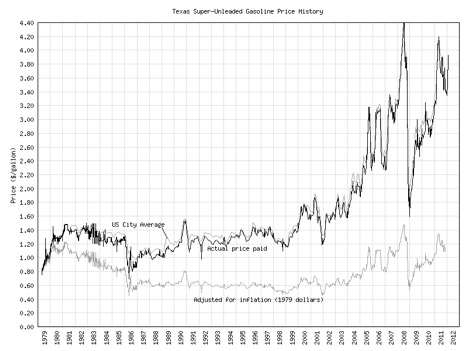
Addendum: I can’t help noting that Newt Gingrich, in his Georgia victory speech once again attacked Obama for the rising gas prices saying they have doubled on the President’s watch. I found that startling and so I checked the facts and found the following graph here.


The reader should note that in 2008, near the end of the Bush Presidency gas prices were higher than the are now. They then dropped precipitously at the beginning of 2009, just as Obama took office, as a result of the recession, which lowered demand. As the economy recovered the price went back up, so that now it is almost as high as it was before the recession. See this Washington Post piece for an analysis of the facts.

Comments are welcome and will be distributed with attribution, unless the writer requests that he/she not be identified.