Showing posts with label Medicaid. Show all posts

Thursday, May 24, 2012

The Inscrutable Center Keeps Moving Rightward (Continued II)

In my last commentary entitled "The Inscrutable Center Keeps Moving Rightward (Continued)," which I urge the reader to re-read, as well as the start of this analysis entitled "The Inscrutable Center Keeps Moving Rightward" I concluded with a quote from the Center for Policy Research on the Ryan budget and the James B. Stewart article defending it:

We have people who want to be part of the inside Washington conversation who praise the budget's courage and integrity. Then we have people who believe in arithmetic who call it what it is: a piece of trash. By the way, Paul Ryan is a very nice guy.

Then again we have another so-called New York Times “centrist” columnist, David Brooks, whose many fulminations have long ago turned me off. I gave up on him many years ago when he advocated what he called a “flat/fair tax” which to me was, and is, an oxymoron. By definition, for the rich and the poor to pay the same tax can never be fair, though I have since then come to wonder whether our present system, isn’t even worse, with the lower earners paying a higher % of their income than the rich.

In any case here is Brooks' “centrist” take on the Ryan plan. He admits:

The Ryan budget would cut too deeply into discretionary spending. This could lead to self-destructive cuts in scientific research, health care for poor kids and programs that boost social mobility. Moreover, the Ryan tax ideas are too regressive. They make tax cuts for the rich explicit while they hide any painful loophole closings that might hurt Republican donors.

But then having said that, he gets to what really upsets him, and it isn’t the outrages of the Ryan plan. Instead he rips into the President for criticizing its (The Ryan Plan’s) “real deficit-reducing accomplishments” (My careful reading of the plan does not reveal any such accomplishments unless you count the unspecified cuts in expenditures, and even then there is not one iota of an increase in revenue) as “trickle-down, … social Darwinists.” To be sure that is strong language, but that hardly makes it inappropriate, for a document that devastates our social safety net and severely cuts taxes for the rich. Mr. Brooks takes particular exception to the term “Social Darwinist” describing it as, as “a 19th-century philosophy that held, in part, that Aryans and Northern Europeans are racially superior to brown and Mediterranean peoples.” That may be the way it was once used, but Brooks should, and undoubtedly does know, that its meaning in 20th century America is as The Atlantic describes it:  

“a term in Richard Hofstadter's 1944 book ‘Social Darwinism in American Thought’ which correctly describes it as a ‘phase in the history of conservative thought’ where ‘nature would provide that the best competitors in a competitive situation would win, and that this process would lead to continuing improvement.”

As we can see Brooks’ attack on the President is ad homonym and without foundation. But that is the way of the so-called middle.

But Mr. Brooks is such a symbol of this so-called middle (I call it a phony middle) that I have to dwell a little longer on Brooks’ writing. As early as June 13, 2011 in an article headed “Pundit Under Protest” he writes, as is his wont, with such an evenness, without regard to facts, as to make the article pathetic. Like any politician without principle, only worse, he knows that his audience likes to hear that there is no difference between the parties. He tries to oblige. He starts out by identifying the malaise that has gripped the country. He writes:

The number of business start-ups per capita has been falling steadily for the past three decades. Workers’ share of national income has been declining since 1983. Male wages have been stagnant for about 40 years. The American working class — those without a college degree — is being decimated, economically and socially. [Emphasis added]
           
Mr. Brooks states a crucial fact, without focusing on a crucial date: 1983. What happened in 1983? Well nothing in particular, except that it was the second year of the Administration of Ronald Reagan, when the country was set upon a dramatic new course, with the mantra being from then on: “ Government is not the Solution – Government is the Problem” and for the next 38 years, except for first two years of the Clinton Administration, that was the guiding principle of our government. It does not follow, that these polices were the cause of the condition that Brooks describes, but one would think that a discussion of that possibility might have been in order. But never mind that. Let’s see what else he says.

Here is what he says about the Republican agenda:

The Republican growth agenda — tax cuts and nothing else — is stupefying boring, fiscally irresponsible and politically impossible… Republican politicians don’t design policies to meet specific needs, or even to help their own working-class voters. They use policies as signaling devices — as ways to reassure the base that they are 100 percent orthodox and rigidly loyal. Republicans have taken a pragmatic policy proposal from 1980 and sanctified it as their core purity test for 2012.

Well so far so good! But of course, being Brooks there is always, “On the other hand.” So here is what he says about Democrats.

…they offer practically nothing. They acknowledge huge problems like wage stagnation and then offer... light rail! Solar panels!... They still have these grand spending ideas, but there is no longer any money to pay for them and there won’t be for decades. Democrats dream New Deal dreams, propose nothing and try to win elections by making sure nobody ever touches Medicare. (Emphasis added)

Boy, what an indictment. But is it true? It may be true of some of the base, but it is not true of the Obama Administration and it is not true of the Democratic Party’s program. It is a contrived caricature. Let us take Medicare. The President proposed and Congressional Democrats passed over almost unanimous Republican opposition $132 billion worth of cuts from Medicare Advantage over 10 years, for which Republicans have been denouncing them as having taking money out of Medicare, if one can believes the hypocrisy. (I am not here going to discuss the merits or lack thereof here – but cite it simply to belie Brooks.)

In addition, months before Brooks falsely alleged that Democrats were unwilling to touch Medicare, in March of 2012 Obama offered as part of a deficit reduction deal with Speaker Boehner, just that, or as the New York Times reported:

The White House agreed to cut at least $250 billion from Medicare in the next 10 years and another $800 billion in the decade after that, in part by raising the eligibility age. The administration had endorsed another $110 billion or so in cuts to Medicaid and other health care programs, with $250 billion more in the second decade.

The offered deal included revenue enhancements, and fell apart when Boehner could not sell that part to his Tea Party-dominated Republican House caucus.

But how can Brooks, say, (with a straight face) “by making sure nobody ever touches Medicare.” The answer can only be that Brooks is no more concerned with facts than the Republicans who he is always defending, or at least falsely equating with a President and a party that is actually trying to do something.

As for Brooks’ assertion that “…they offer practically nothing,” “'Let's look at the record” in the immortal words of Al Smith: Mr. Brooks does not have to look at what has been proposed, just at what has been achieved, which because of Republican obstructionism is much less than what has been proposed. See the accomplishments as of November 25, 2009 here.

More has been accomplished since then, but of course upon the election of Scott Brown in Massachusetts, Democrats and the President lost their 60-vote majority in the Senate. With a unanimous Republican determination that nothing will pass with less than 60 votes – which means a vote of 59 in favor, 41 against, or even 35 against, defeats a bill, not much more can be accomplished, and with Republicans capturing the House, gridlock is the order of the day. But here again the suggestion that both parties are at fault for not being willing to compromise, belies the facts. Even tax cuts proposed by the Administration, are blocked, even though the Republican mantra is that tax cuts are always good, but I guess they mean only for the rich.

But Tom Friedman, writing in the New York Times, isn’t much better. He thinks that the solution to all our problems is a third party. See my discussion entitled "The Media And Their Columnists."

We will never solve any problems if we constantly seek a false equivalency between the parties, or seek magic from outside them. Let the facts take us where they may, but let us not indulge in a false delusion in an effort not to have to choose. That leaves as either not voting, or voting on the basis of Eeny, meeny, miny, moe, or throwing our vote away on a third party.

But before I close this subject I must examine one more column by Brooks. It is dated April 16, 2012 and is entitled “The White House Argument.” I suggest the reader examine it before my next post. It is one of Brooks’ best jobs yet at sophism. But like all his others, it does far better at obfuscation than at clarification.

Comments, questions, or corrections, are welcome and will be responded to and distributed with attribution, unless the writer requests that he/she not be identified.

Friday, March 09, 2012

Social Security – An Honest Evaluation

In my last post entitled "The Truth is a Sometime Thing? (Discussion)" I moved from a focus of misinformation, resulting from outright lies in many cases, on the part of the Right, to the misleading, destructive and naïve opposition to all changes in the benefits provided under Social Security, Medicare and Medicaid. Yet the three programs are financed so differently from each other, have such different benefit programs, and have such different financing problems, that a discussion of the three does not lend itself to clarity.

Instead let me start by defining the three programs. Social Security is often thought of as a retirement program that only benefits those over 67. It is in fact a program that covers a large group of benefits, but for purposes of our discussion we need to focus on what is the main part of the program that is often referred to under the acronym OASDI, which stands for Old Age, Survivors, and Disability Insurance or RSDI, which stands for Retirement, Survivors, and Disability Insurance.

It is this program that I want to address today.

First some background. The Social Security Trust Fund has not been stolen for other purposes. It is intact and is invested in government securities, the safest in the world. The confusion about the fund derives from the fact that during the Johnson Administration (1968) the “unified budget” was enacted. The official purpose of the Act “was an effort to rationalize what the Commission viewed as a confusing budget presentation.” I have always thought, and continue to think that it was intended to hide the huge deficits that Johnson was incurring in simultaneously fighting the Vietnam war and pursuing the “Great Society”. At that time the Social Security Trust fund was running very substantial surpluses, and so including the Trust fund as part of the unified budget masked the size of the deficit. However, in 2010 expenditures, for the first time, exceeded income from the payroll tax, and will do so hereafter. See here

Nevertheless, the combined trust funds will continue to grow because projected interest earnings of $115 billion substantially exceed the non-interest income deficit. Beginning in 2023, however, net redemptions of trust fund assets with General Fund payments will be required, until its assets are exhausted in 2036. After trust fund exhaustion, continuing tax income will be sufficient to pay 77 percent of scheduled benefits in 2036 and 74 percent in 2085. Ibid.

But that means that even without any changes full payments of Social Security benefits would be paid to all those who are now 44 years old or older, which is better than the guarantee offered by the Ryan budget by one year, and unlike the Ryan budget benefits at a reduced rate would continue to be paid.

However I don’t believe that is good enough. We need to make sufficient changes so that people who are now 24 years old and are paying into the trust fund for the benefit of older generations are guaranteed full benefits. If we don’t do that, these younger generations will see little reason to support the system, and it will be doomed much earlier, simply because young people will insist that they not pay into a system from which they will not draw the full benefits of older generations.

What should we do?

Gail Collins writing in the New York Times posits:

The basic answer to fixing the long-term Social Security imbalance is just to eliminate the payroll tax cap, which currently exempts all income over $110,100 a year. Do that, and you have solved the problem. Politically speaking, you would probably have to agree to mix a limited tax increase with one of the fixes desired by fiscal conservatives, like reducing benefits for the wealthy, or changing the cost-of-living adjustment or, yeah, raising the retirement age a little. But the main answer is that cap, and anybody who refuses to even discuss the payroll tax cap is not serious about fixing Social Security.

She is right in every respect except one crucial one: Republicans are not serious about fixing Social Security. They are committed on the one hand to abolishing what they call “the Nanny State” and on the other to the proposition that under no circumstances must taxes ever be raised, and even that any “reform” of the tax system must never result in an increase in revenues. This even extends to enforcement of the tax laws. As recently as October of 2011 “The House Appropriations Committee … passed legislation cutting the IRS budget by $600 million, providing the IRS with $11.5 billion in fiscal year 2012. The Senate Appropriations Committee was more generous, providing $11.7 billion for the IRS, but both amounts would be far below what the IRS was given last year.” See here.

Furthermore the IRS enforcement arm falls under the rubric “discretionary spending” and is subject to spending caps under the Budget Control Act conceived as part of the 2011 debt ceiling deal. The Administration is asking that current caps placed on the IRS enforcement budget be lifted and that this enforcement budget not compete with other national priorities for funding.” See here. In making this request it was pointed out that: “The latest IRS tax gap report (January 2012) showed that American taxpayers under reported their taxes to the tune of $450 billion dollars in 2006;” Ibid. See also here.

If those $450 billion dollars were to be collected over the next ten years it would amount to $4.5 trillion, enough to substantially wipe out the deficit and put SS on a sustained basis. But it ain’t going to happen. Nor will Congress allow the cap on SS payroll taxes be raised, unless Obama were to win the election by a landslide so large as to bring with him a House with a substantial majority and a Senate with a majority above 60, so as to be filibuster proof. It ain’t going to happen, particularly since in the November election “Democrats will defend 23 seats, while Republicans will defend 10." See here.

The bottom line to all this is that Gail Collins recommendation is fine as a matter of policy, it is not politically feasible.

Which means - I hate say it – Social Security will have to be saved without raising the cap, or in other words, by cutting benefits sufficiently to make it viable well into the future. To do otherwise is to hold ones breath till Republicans give in – they don’t care. So we do nothing or we do what Republicans will allow, or as Gail Collins says:

...like reducing benefits for the wealthy, or changing the cost-of-living adjustment or, yeah, raising the retirement age a little.

And adding to that the following possibilities set out by the Social Securities Administration, revising the benefit formula, revising the benefit and contribution base, extending OASDI program coverage, and/or Changing the investment requirements for the combined Old-Age and Survivors Insurance (OASI) and Disability Insurance (DI) Trust Funds.

And if the President can maneuver some increase in revenue, great, but (and this is essential) we must have his back. He must not have to worry about the support of his liberal wing.

The point I am making is the choices are stark. Nothing will happen unless Republicans allow it. The President needs room to maneuver. Liberals have attacked him when he tries to be practical. Unless they accept what must be accepted, Social Security (and Medicare and Medicaid) will die. Half a loaf is better than none, etc.

It is an unpleasant reality! But it is reality! Until such a day as the American people wake up to the fact that Republicans are not the friend of ordinary people, they can block all real reforms. To save something, we must have the wisdom to not allow the best to be the enemy of the “good.” The alternative could be the worst, i.e. the Republican plan that would end the safety net, or at the very least shred it to the point were it no longer serves its purpose. It doesn’t matter whether it is Santorum, or Gingrich, or Romney, on this point they are all on the same page. Time is running out.

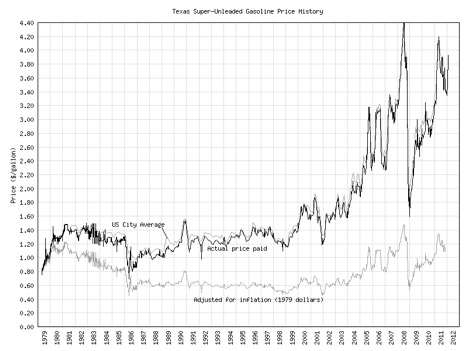
Addendum: I can’t help noting that Newt Gingrich, in his Georgia victory speech once again attacked Obama for the rising gas prices saying they have doubled on the President’s watch. I found that startling and so I checked the facts and found the following graph here.


The reader should note that in 2008, near the end of the Bush Presidency gas prices were higher than the are now. They then dropped precipitously at the beginning of 2009, just as Obama took office, as a result of the recession, which lowered demand. As the economy recovered the price went back up, so that now it is almost as high as it was before the recession. See this Washington Post piece for an analysis of the facts.

Comments are welcome and will be distributed with attribution, unless the writer requests that he/she not be identified.