Showing posts with label IRS. Show all posts

Friday, March 09, 2012

Social Security – An Honest Evaluation

In my last post entitled "The Truth is a Sometime Thing? (Discussion)" I moved from a focus of misinformation, resulting from outright lies in many cases, on the part of the Right, to the misleading, destructive and naïve opposition to all changes in the benefits provided under Social Security, Medicare and Medicaid. Yet the three programs are financed so differently from each other, have such different benefit programs, and have such different financing problems, that a discussion of the three does not lend itself to clarity.

Instead let me start by defining the three programs. Social Security is often thought of as a retirement program that only benefits those over 67. It is in fact a program that covers a large group of benefits, but for purposes of our discussion we need to focus on what is the main part of the program that is often referred to under the acronym OASDI, which stands for Old Age, Survivors, and Disability Insurance or RSDI, which stands for Retirement, Survivors, and Disability Insurance.

It is this program that I want to address today.

First some background. The Social Security Trust Fund has not been stolen for other purposes. It is intact and is invested in government securities, the safest in the world. The confusion about the fund derives from the fact that during the Johnson Administration (1968) the “unified budget” was enacted. The official purpose of the Act “was an effort to rationalize what the Commission viewed as a confusing budget presentation.” I have always thought, and continue to think that it was intended to hide the huge deficits that Johnson was incurring in simultaneously fighting the Vietnam war and pursuing the “Great Society”. At that time the Social Security Trust fund was running very substantial surpluses, and so including the Trust fund as part of the unified budget masked the size of the deficit. However, in 2010 expenditures, for the first time, exceeded income from the payroll tax, and will do so hereafter. See here

Nevertheless, the combined trust funds will continue to grow because projected interest earnings of $115 billion substantially exceed the non-interest income deficit. Beginning in 2023, however, net redemptions of trust fund assets with General Fund payments will be required, until its assets are exhausted in 2036. After trust fund exhaustion, continuing tax income will be sufficient to pay 77 percent of scheduled benefits in 2036 and 74 percent in 2085. Ibid.

But that means that even without any changes full payments of Social Security benefits would be paid to all those who are now 44 years old or older, which is better than the guarantee offered by the Ryan budget by one year, and unlike the Ryan budget benefits at a reduced rate would continue to be paid.

However I don’t believe that is good enough. We need to make sufficient changes so that people who are now 24 years old and are paying into the trust fund for the benefit of older generations are guaranteed full benefits. If we don’t do that, these younger generations will see little reason to support the system, and it will be doomed much earlier, simply because young people will insist that they not pay into a system from which they will not draw the full benefits of older generations.

What should we do?

Gail Collins writing in the New York Times posits:

The basic answer to fixing the long-term Social Security imbalance is just to eliminate the payroll tax cap, which currently exempts all income over $110,100 a year. Do that, and you have solved the problem. Politically speaking, you would probably have to agree to mix a limited tax increase with one of the fixes desired by fiscal conservatives, like reducing benefits for the wealthy, or changing the cost-of-living adjustment or, yeah, raising the retirement age a little. But the main answer is that cap, and anybody who refuses to even discuss the payroll tax cap is not serious about fixing Social Security.

She is right in every respect except one crucial one: Republicans are not serious about fixing Social Security. They are committed on the one hand to abolishing what they call “the Nanny State” and on the other to the proposition that under no circumstances must taxes ever be raised, and even that any “reform” of the tax system must never result in an increase in revenues. This even extends to enforcement of the tax laws. As recently as October of 2011 “The House Appropriations Committee … passed legislation cutting the IRS budget by $600 million, providing the IRS with $11.5 billion in fiscal year 2012. The Senate Appropriations Committee was more generous, providing $11.7 billion for the IRS, but both amounts would be far below what the IRS was given last year.” See here.

Furthermore the IRS enforcement arm falls under the rubric “discretionary spending” and is subject to spending caps under the Budget Control Act conceived as part of the 2011 debt ceiling deal. The Administration is asking that current caps placed on the IRS enforcement budget be lifted and that this enforcement budget not compete with other national priorities for funding.” See here. In making this request it was pointed out that: “The latest IRS tax gap report (January 2012) showed that American taxpayers under reported their taxes to the tune of $450 billion dollars in 2006;” Ibid. See also here.

If those $450 billion dollars were to be collected over the next ten years it would amount to $4.5 trillion, enough to substantially wipe out the deficit and put SS on a sustained basis. But it ain’t going to happen. Nor will Congress allow the cap on SS payroll taxes be raised, unless Obama were to win the election by a landslide so large as to bring with him a House with a substantial majority and a Senate with a majority above 60, so as to be filibuster proof. It ain’t going to happen, particularly since in the November election “Democrats will defend 23 seats, while Republicans will defend 10." See here.

The bottom line to all this is that Gail Collins recommendation is fine as a matter of policy, it is not politically feasible.

Which means - I hate say it – Social Security will have to be saved without raising the cap, or in other words, by cutting benefits sufficiently to make it viable well into the future. To do otherwise is to hold ones breath till Republicans give in – they don’t care. So we do nothing or we do what Republicans will allow, or as Gail Collins says:

...like reducing benefits for the wealthy, or changing the cost-of-living adjustment or, yeah, raising the retirement age a little.

And adding to that the following possibilities set out by the Social Securities Administration, revising the benefit formula, revising the benefit and contribution base, extending OASDI program coverage, and/or Changing the investment requirements for the combined Old-Age and Survivors Insurance (OASI) and Disability Insurance (DI) Trust Funds.

And if the President can maneuver some increase in revenue, great, but (and this is essential) we must have his back. He must not have to worry about the support of his liberal wing.

The point I am making is the choices are stark. Nothing will happen unless Republicans allow it. The President needs room to maneuver. Liberals have attacked him when he tries to be practical. Unless they accept what must be accepted, Social Security (and Medicare and Medicaid) will die. Half a loaf is better than none, etc.

It is an unpleasant reality! But it is reality! Until such a day as the American people wake up to the fact that Republicans are not the friend of ordinary people, they can block all real reforms. To save something, we must have the wisdom to not allow the best to be the enemy of the “good.” The alternative could be the worst, i.e. the Republican plan that would end the safety net, or at the very least shred it to the point were it no longer serves its purpose. It doesn’t matter whether it is Santorum, or Gingrich, or Romney, on this point they are all on the same page. Time is running out.

Addendum: I can’t help noting that Newt Gingrich, in his Georgia victory speech once again attacked Obama for the rising gas prices saying they have doubled on the President’s watch. I found that startling and so I checked the facts and found the following graph here.
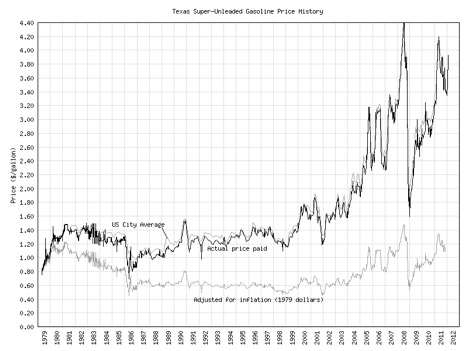


The reader should note that in 2008, near the end of the Bush Presidency gas prices were higher than the are now. They then dropped precipitously at the beginning of 2009, just as Obama took office, as a result of the recession, which lowered demand. As the economy recovered the price went back up, so that now it is almost as high as it was before the recession. See this Washington Post piece for an analysis of the facts.

Comments are welcome and will be distributed with attribution, unless the writer requests that he/she not be identified.

Sunday, January 22, 2012

In Defense of Romney – Discussion


On January 19th I posted my commentary "In Defense of Romney."

In response thereto Pam Tisza of Branchburg, NJ wrote:

You did not comment on Senator Bernie Sanders bill to counteract the big money in the elections---or did I miss it ????

To which I replied:

No, I didn't and I am not sure what bill you are referring to. Do you mean his introduction of a Constitutional amendment to overrule Citizen United? If so, I am glad he did that, but it is not very newsworthy, since it is not likely to go anywhere. I expect it will not even get out of committee and if it does it will not get a majority, at least at this time around, and it need 2/3 of both houses in order to go to the states for ratification, where it needs 3/4 of the state legislatures (both houses) to become part of the Constitution, given that Democrats now control 35 total chambers while Republicans are the majority in 60 chambers. See here. There are three tied chambers with the addition of the Virginia State Senate.

Article. V. of the Constitution provides:
"The Congress, whenever two thirds of both Houses shall deem it necessary, shall propose Amendments to this Constitution, or, on the Application of the Legislatures of two thirds of the several States, shall call a Convention for proposing Amendments, which, in either Case, shall be valid to all Intents and Purposes, as Part of this Constitution, when ratified by the Legislatures of three fourths of the several States, or by Conventions in three fourths thereof, as the one or the other Mode of Ratification may be proposed by the Congress;…”

If you were referring to something other than the above, please advise. In fact please let me have your further comments in any case.

Her rejoinder was:

Thanks for correcting me. I went back and read the original e-mail I got on this and they mention "constitutional amendment”; but then go on as if it is a bill. Poor reading on my part. I agree with you. Nice idea--no hope.

I must add that despite the fact that at present there is no hope of enacting such an amendment, many liberal organizations are organizing petition drives in support of such an amendment, which is a good idea. It must be kept in front of the public.

Albert Nekimken of Vienna, Virginia challenged me on my views with respect to the activities of Bain Capital, writing:

I don't share all of your enthusiasm about Romney's version of private equity capitalism, but I agree with your view that all income from all sources should be taxed at the same rate. As for the corrosive effect of money on politics, the Harvard professor, Lessig, who (in his new book) proposes that ALL political campaigns be publicly financed through a $1 per taxpayer, voluntary contribution on his tax return, which seems like the most promising solution. 

You were correct to emphasize the dire issue of the high cost of education today--and rising. This is killing social mobility. Student debt (now inextinguishable even in bankruptcy) is the next huge bubble ready to burst. Indebted and unemployed students cannot repay these debts. So long as educational institutions are able to coerce/convince students to incur debt as a condition of enrollment, there are/will be no brakes on the rise in cost. When the bubble bursts, many schools will go with it.

To which I posed the following question:

I am interested in your views on "Romney's version of private equity capitalism.” Do you think it is destructive? Do you think parts of it should be illegal? If so what parts? If you can, please be as specific as possible.

And added:

As for Lessig's proposal, we already have a provision in the tax code for deducting, not $1 but $3 for Presidential campaigns. The tax code provides, for a Presidential Election Campaign Fund which helps pay for Presidential election campaigns. The fund seeks to reduce candidates' dependence on large contributions from individuals and groups and seeks to place candidates on an equal financial footing in the general election. Tax Return 1040 provides: “If you want $3 to go to this fund, check the box. If you are filing a joint return, your spouse can also have $3 go to the fund. If you check a box, your tax or refund will not change."

However this check off has come out of favor. "...participation in the tax checkoff program has declined each year, from a high of 28.7% for 1980 returns, to 7.3% for returns filed with the Internal Revenue Service (IRS) in 2010." See here.

There is a limit in how much one is allowed to spend to get matching funds. In 2008, presidential primary candidates who accepted public funding had a maximum entitlement of $21,025,000 (50 percent of $42,050,000). (Ibid) It was because of this limit that Obama waived the public funding in 2008 to much criticism. He felt he could raise and spend much more than the limit.

As I understand Lessig, all he is advocating is essentially to extend this system to Congress. I would favor this, but unless there is a limit on contribution and spending, it would end up the same as the Presidential fund. As long as Citizen United stands, and I am not hopeful of an overrule in less than two decades, we are stuck, money will rule.
On improving mobility, making decent education available to all, regardless of economic status, is the ultimate class leveler and vouchers can never achieve this. Here too we need to reverse the financing curve. The poor need more financing than the rich, not less. Even in school buildings many are antiquated. No corporation would or could operate in such antiquated buildings. But as long as money rules this will not happen. I hate to say this, but I am not optimistic.

Nekimken responded:

You likely saw the article in today's New York Times entitled “Taxes at the Top” and another one entitled "Romney’s Estate Tax Cut Would Save the Koch Brothers Up to $8.7 Billion Each" but I call them to your attention in case you missed them, it because they bears on the question at hand: Romney's wealth. 

To tell the truth, I have mixed feelings about the role of private equity in modern capitalism. On the one hand, I believe it does serve a useful tool of Schumpeter's "creative destruction" by feeding on weak companies like insects on the forest floor, paving the way for new growth. 

On the other hand, much private equity activity appears to be motivated, not by any long-term desire to turn around failing companies by making new investments and providing new management in order to make them successful and grow and, presumably, to create new jobs, but by a desire to create a transaction that results in a quick profit. 

On the contrary, most of this activity seems to be motivated by a short-term desire to strip assets from a failing company, reduce staff, and (often) to loot the company pension fund. Often private equity owners load a newly acquired company with fresh, unsustainable debt that can be made to "disappear" in bankruptcy, or in a future sale at an inflated price to a bigger fool. 

As a result, much of what private equity firms do falls into the category of "financial engineering" that serves no useful purpose except to make a few "engineers" very wealthy. Unfortunately, I can't think of any coherent and effective way to prevent this. 

The situation is so complex that I don't believe there is any way to regulate this area of finance in order to prevent them from plundering weak companies and destroying jobs. Better would be to reform tax policy (i.e., tax all income from all sources at the same rate), reform bankruptcy and pension laws, and protect employees more effectively, perhaps by making company owners pay severance and re-training expenses for employees who lose their jobs--as is the case in Europe. 

I hope this is helpful.

I concluded this discussion with:

I really don't know enough about how a company like Bain operates to agree or disagree with your description of "financial engineering." However, while your description of the European system of "making company owners pay severance and re-training expenses for employees who lose their jobs--as is the case in Europe" has appeal, I fear that it may be counter-productive. It has long been charged that these potential burdens make employers reluctant to hire in the first place, and I fear that there is truth in this.

Comments are welcome and will be distributed with attribution, unless the writer requests that he/she not be identified.

Wednesday, March 04, 2009

The Stimulus Bill

How did we get from there to here? How did we get from the booming economy of the Clinton years to the collapse of the economy in the eighth year of the Bush Administration?

It really all began during the Clinton Administration. Clinton had proved that not all tax cuts are stimulative and not all tax increases dampen economic activity. As the bible says (Ecclesiastes 3) and Pete Seeger made famous, “There is a time for everything, and a season for every activity under heaven:”

That is a lesson that the minions of the Republican Party have not learned or as has often been said about them, “They have never forgotten anything and they have never learned anything.”

They are wed to the proposition that taxes need to be cut all the time, and never, never raised. When Clinton proposed raising some taxes on the rich, the economy that he inherited from Bush pére was in the doldrums but interest rates set by the Fed were high. Clinton reached an agreement with Fed Chairman, Alan Greenspan, that if he reduced the deficit the Fed would lower interest rates. The result was a booming economy and a booming stock market. In fact the stock market entered a period of such an exaggerated boom that it caused Greenspan to coin the now famous phrase, “irrational exuberance", but he did nothing about it despite the fact that it was obvious that the stock market boom was caused by rampant speculation fueled to a large extent by buying on margin, i.e. using borrowed money to speculate in the market, or as it is called “leveraging” ones investments. The Fed has the power to raise or lower this requirement (see here) but Greenspan in keeping with his then philosophy of believing that the markets regulate themselves left the market to its own devices.

I believe that set the tone for the Bush fils eight years of wild speculation by the banks at unheard of levels of leveraging their loan portfolios. At the same time, following the policy that all tax cuts are good, these years brought about some of the largest tax cuts ever, leading to huge deficits, which were defended in the words of V-P Dick Cheney, “Reagan proved deficits don’t matter” and with the enthusiastic support of the Republican party in Congress.

What a change an Administration makes. Now, suddenly running up deficits, say Republicans, is “generational theft.” But are they really concerned with deficits even now. They agree that we need to stimulate the economy, and they agree that reducing the deficit now is the wrong prescription, but they want to do it with more tax cuts for, you guessed it, the wealthy. They don’t want to “redistribute wealth” after having presided over the greatest redistribution of wealth upward, toward the wealthy, in the history of the US. As a matter of fact the wealth redistribution upward began in the Reagan years. In 1980 the top 10% of households accounted for 33% of total household income. By 2000 this group accounted for 44% of total household income. Today the top 1% of households receives more pretax income than the bottom 40% and the distribution of wealth is even more lopsided. The top 1% of households own nearly 40% of total household wealth -- more than the bottom 90% of households combined -- and earns half of all capital income. Income and wealth are more unevenly distributed among Americans than at any time since the Jazz Age of the 1920s.

According to the Economic Policy Institute the rich-poor gap widened with the nation's top one percent now collecting 23 percent of total income, the biggest disparity since 1928. According to the IRS there are now 47,000 Americans worth $20 million or more, an all-time high.

What does this tell us? Not all tax cuts and not all deficits are equal. When wealth is inordinately pushed upwards as in 1928 and now in 2008, it will no longer be invested prudently, but rather it leads to rampant speculation leading to a speculative boom followed by a bust.

Only a reversal of this trend, with a pump priming of the economy and a loosening of credit can reverse the impending disaster. More tax cuts for the wealthy can only compound the disaster and the cry of Republicans that the answer lies in tax cuts for “small business” is not the answer either. First of all, small business does not refer to mom and pop stores. “Small business” according to the Small Business Administration includes all businesses that have fewer than 500 employees and, e.g. in construction $33.5 million average annual receipts, hardly what one would call “mom and pop stores.

While they are the largest creators of jobs in our economy, they produce jobs when there is demand, and consumers produce 70% of demand.

If consumers aren’t buying no amount of tax reduction for the suppliers will cause them to produce that for which there is no market. It is the fallacy of supply side economics, which is really another word for redistribution of income upwards.

What is stimulative? Anything that puts money in the hands of those who need it most and who will spend it immediately out of necessity. Thus supplying money to those who are unemployed is the best stimulus. Even if they are simply given the money it will be stimulative because it will be spent creating demand. But this is not the best stimulus because it has no multiplier effect. It is better to employ that person. If we employ him/her to dig a ditch and fill it, it will be stimulative, but it has no multiplier effect. But if we employ that person, e.g. to seed the Capitol lawn we get a multiplier. Not only when they spend, will they cause businesses who manufacture the goods and who warehouse it and who retail it, etc. to ramp up production, causing them to hire additional people to meet the demand which in turn causes more spending, causing a chain reaction which reverses the cycle of layoffs, but in order to seed the lawn, seeds have to be bought, construction equipment has to be rented, each of which creates jobs leading to more jobs, and in the end we have the benefit of a better lawn. But this small bit of creative spending was ridiculed by Republicans and dropped from the bill. Yet unlike large projects, which give more permanent benefit, nothing could have been more “shovel ready.”

Giving money to the states is another example of a provision in the stimulus bill which could not be improved upon, because if we want quick results what can be better than hiring people, if it is not keeping them from being fired. States, unlike the federal government, have to have balanced budgets and so when as a result of the loss of tax revenues due to the recession, they are faced with deficits, they have no choice but to increase taxes or lay off employees, including police, firemen, teachers, etc. They have to stop repairing roads and they have to stop capital projects already under way or shovel ready. That is not what we need when we are trying to start such programs, not stop them. Yet this was the “pound of flesh” our three “moderate Republicans” demanded as a condition of their supplying the votes needed to stop a filibuster.

For a discussion of the filibuster see the paragraph preceding the antepenultimate one here.

They insisted that the amount allocated for aid to states be cut by $40 billion.

We might well ask why this opposition. Bobby Jindal, the governor of Louisiana, the official Republican spokesman made it clear that Republicans were stills stuck on doing nothing. His main theme was to rely on Bush’s failure in Katrina to show government doesn’t work. How ironic. Republicans, after eight years of blindly supporting Bush are now running against him. Besides they seem unable to tell any story without lying. It appears that Jindal’s story about rescuers being threatened by federal agents because they didn’t have insurance and that he was there, was a total fabrication.

They are now even going so far as to rewrite the history of the Roosevelt New Deal. Now we hear that the New Deal was totally ineffective. As I will demonstrate in my next commentary the facts and figures belie that, but it shows that no distortion, nor any lie that will advance their agenda is off the table.

Monday, December 22, 2008

The Estate Tax II

A careful search of the web reveals that the main argument advanced is that the tax endangers family farms. But they are not arguing for a greater exemption before the tax takes its bite. They are arguing for total repeal as though a “family farm” might be worth an infinite amount and they use hysterical, false claims to support their drive. Yet, amazingly enough they have found supporters even among main street groups. In 2005, long before the Bush repeal was to take effect in full, the American Family Business Institute and Free Enterprise Fund announced a $15 million campaign. Its radio ad, which ran in Montana, and was to be replicated in numerous other states, including New York, had the announcer intone the following:

“You work hard all your life. You pay your taxes and play by the rules, and, yeah, you're proud of what you've accomplished. You'd like to leave your family farm or business to your kids. It's a legacy, something they can hold onto. It's the American dream, right? But the IRS death tax can turn that dream into a nightmare. When you die, the IRS can bury YOUR FAMILY in crippling tax bills. IT CAN COST THEM EVERYTHING. What's worse, the death tax is a double tax on all you've worked to build. The death tax is wrong. It's unfair. And this year, Montana's family business owners and farmers have joined together to kill this unjust tax, before it destroys one more family legacy.” (Caps added for emphasis)

What is the truth? The likelihood that many who heard that ad would be affected is extremely small.

Less than 3% of deceased adults in 2002 (before any of the Bush tax cuts went into effect) had estates subject to the tax, according to the nonpartisan Urban-Brookings Tax Policy Center and figures from the IRS. As for “Cost them everything,” of the 440 taxable family farm and business estates in 2004, two out of five paid an average rate of only 1.6 percent. These were taxable estates valued at less than $2 million. Very large estates valued at over $20 million paid an average effective rate of just over 22 percent. No one no matter how rich could lose “everything.”

But it isn’t even a matter any more of going back to the quite reasonable tax rates that Bush inherited. Obama’s plan is to set the exemption at $3.5 million per person ($7 million for couples), which means that all but the very wealthy would be exempt from any inheritance tax at all, and the top marginal rate on a graduated basis would only be 45% reducing the average effective rate to well under 22%

But the opponents are not satisfied with such generous reduction in tax. They will settle for nothing short of repeal and they will run the most incendiary and misleading ads to further their goals. Here is a TV ad that ran in 2005.

“Announcer: They freed the world from tyranny, then came home to build family businesses and farms. Heroes in war and peace. They paid taxes all their lives, but now the IRS hits this "Greatest Generation" with an unjust double tax, the death tax.”

(Voice of a supposed WWII Vet) “In war and peace, my generation stood up for what's right. Join us now and help us end the unfair death tax.”
The TV ad featured World War II veterans from the popular HBO series “Band of Brothers,” Actually; of course, WWII vets are not likely to be subject to the estate tax when they die. The estates of veterans and non-veterans alike owed taxes only on amounts exceeding $1.5 million in 2005. How many veterans are likely to have an estate of that size, and under Obama’s plan the exemption would go to $7 million per couple, and then the tax rate would only gradually escalate.

As for the double tax argument, I have already dealt with this in previous discussions. First of all the rich are escaping without paying any capital gains tax at all, because unrealized capital gains escape capital gains taxation when passed onto heirs, and secondly as I have pointed out all taxes are in one way or another double taxation.

But none of this fazes the repeal lobby that represents the very rich such as the Walton family, who own Walmart. They continue to hide behind the phony argument about family farms. For instance deltafarms.com posted this on the web in November of 2008.

“To exemplify how this can affect a family farm, look at how the varying estate tax rates over the next three years impact a 2,500-acre farm valued at $2,500 per acre. With structural improvements and equipment accounting for an additional 15 percent of value, the total estate would be worth $7,187,500.”

I don’t know about a family farm of 2,500 acres. I wonder how many family farms are that large, if any. But Obama has even taken the wind out of their sails. An exemption of $7 million per couple would take care even of this very wealthy estate.

So the Estate tax as now proposed effects only the very richest at the top of our increasingly stratified society. It seems self evident that the Obama plan is far too generous to those who want to build and maintain a permanent aristocracy in America.

Finally we need to focus on the effect of a repeal. According to the Center on Budget Policy Priorities the estate tax encourages billions of dollars in charitable donations each year since donations substantially reduce the tax on large estates and its repeal would cost more than $1 trillion over the first ten years, 2012-2021, in which its cost would be fully felt.

Given these facts it is incredible that there are those who still would advocate this drastic radical idea.

Sunday, November 30, 2008

The Capital Gains Tax

In my last commentary entitled, “The Graduated Income Tax," I pointed out that the reason the very rich pay a large percentage of our taxes is because they have most of the income and most of the wealth, and the gap between the haves and the have-nots gets ever greater. I showed that the graduated income tax only closes the gap a miniscule amount since after tax income shows only a slight closing of that gap.

I quoted Warren Buffett as pointing out that in the final analysis despite our theoretical graduated income tax, his marginal tax rate is 17.7 % on the $46 million he made last year, without trying to avoid paying higher taxes, while his secretary, who earned $60,000, was taxed at a marginal tax rate of 30%.

While many provisions of the tax code play a part in this, I have little doubt that a major reason is the favorable treatment given capital gains. It has often been said that America has a Protestant work ethic that places special value on work, and everyone in American society has an obligation to “work.” This, however, is not reflected in our tax system, for here we penalize work with a substantially higher tax rate than passive income, i.e. income earned without work. At the moment earned income is taxed at a marginal tax rate of 35% on incomes over $357,000, (This is extremely low by historical standards. Between 1941 and 1945 taxpayers with incomes over $1 million faced a top marginal rate of 94 percent.) but unearned income or capital gains (if held for more than a year) and dividends are taxed at 15%. I submit that there is no justifiable reason to tax unearned income at a rate below that for income, which is earned by actually working. While people at the lower end of the income scale often make a small percentage of their income from capital gains, those with high incomes, who often have never made a cent in their lives by the sweat of their brow, or even from intellectual effort, having often inherited their wealth, make the bulk of their income from unearned income. Furthermore, they have every opportunity to cheat even from this minimum burden, for while the wage earner has his income reported to the IRS by his employer, the investor is on his honor when reporting the cost of his asset, (stock or other) and can easily inflate his cost (“basis” in tax lingo) and even misrepresent the date of the acquisition to gain long term status (assets held less than a year don’t get this favorable treatment). Under present Internal Revenue law the broker must report the sale of stock to the IRS, but he is not required to report a purchase. Thus the IRS has no way of knowing whether tax evasion is occurring short of an audit, which is rare. I strongly urge, (and I am sorely disappointed that no major columnist or candidate has addressed this issue) that brokers and other sellers of assets, including real estate agents, be required to report the purchase and sale of all assets subject to tax.

I also believe that the present system which taxes capital gains only when the asset is sold (realized capital gain) distorts the capital markets. It is far better for the capital markets to function when the only consideration is to maximize ones gains or minimize ones losses, without tax consideration being a major factor in decision making. This becomes particularly egregious when one considers that the wealthy can postpone selling their assets indefinitely if they want to avoid paying taxes, while those in lesser financial positions must frequently sell to meet expenses, particularly after retirement. I believe that it would be far better if the value of the asset be assessed at the end of the taxable year (easily done with stocks and bonds) and that to the extent that the value of the asset has increased or decreased be used as the taxable gain or loss minus an allowance for inflation. It becomes an outright scandal when we consider that those who can afford to not sell their assets before they pass away, can avoid paying a capital gains tax altogether on their gains, since their heirs get the assets with a basis, not as of acquisition, but as of the death of the legator thus escaping ALL capital gains taxes.

Those who generally argue for reducing the tax burden on those who can best carry it maintain that dividends and capital gains are different from other income and not only deserve favored treatment but should be exempt from all taxation. Their arguments are so that numerous that it is difficult to set them all forth even without pointing out their fallacies, but let me attempt to cover at least the most prominent ones within the circumscribed length of this article. See here.

1.) “High effective capital gains rates reduce the capital stock and lower growth and productivity.” I discussed this in my previous article on the income tax. More capital will not be deployed unless there is consumer demand, which according to the Wall Street Journal accounts for 70% of GDP.

2.) “Capital gains taxes encourage a "lock-in" effect that discourages investors from selling their assets.” I think there is merit in this, which is why I advocate taxing all gains at the end of each fiscal year instead of at the time of sale.

3.) “Capital gains are not income -- as the Supreme Court held for many years, and even after the passage of the 16th Amendment.” This is more a reflection on the makeup of the Supreme Court than an argument and the Supreme Court has long since reversed this erroneous holding.

4.) “Capital gains are already taxed more than once through the corporate and personal income tax -- and taxing appreciating stocks or real estate can be a third layer of taxation.” This is the favored argument not only for not taxing capital gains and dividends, but for not taxing estates, but it is nonsensical, because ALL taxation is of a multiple nature. When a worker’s pay is taxed is it double taxation because that money was already taxed when the corporation earned it? Is it double taxation when a worker is taxed and then pays a portion to his grocer, who is taxed, who then pays his doctor, who is taxed, who pays his landlord who is taxed? The whole point of taxes, and the only way it can work, is that money, or any asset, is taxed every time it changes hands. What the corporation earns is taxed and when it passes those earnings to its stockholders it is taxed - it has changed hands. An even better illustration is the real estate tax where the same piece of property is taxed year after year. If it were otherwise the government would get a tax once and never again.

5.) “Lowering capital gains taxes substantially raises tax collections and increases tax payments by the rich” (Source) This is true in the short run but untrue in the long term, or as Professor Richard Serlin of the University of Arizona put it, “When there is a cut in the capital gains tax rate, there is an incentive to sell the stock then, and get the lower tax rate before a new administration raises it again. Thus, when the capital gains tax is cut, there is a rush of investors selling stocks to pay their capital gains taxes now, when the rate is law, rather than later when the rate may be raised back up. Capital gains tax revenue to the government thus may go up now, but it will go down later, and it will go down overall.”

But logic is not the strong point of the advocates of reverse taxation, i.e. placing the greatest tax burden on those who make the least, who are to be grateful for the opportunity to serve those who make the most.

Friday, August 08, 2008

The Deficit & Spending

That we are in an economic downturn there can be no doubt but to blame it on the normal cyclical effects of the business cycle and to the price of oil is to ignore, as some would like, the failed policies of the past eight years. When this Administration with its Republican Congress took office we had just completed eight years of economic prosperity. When Clinton took office he inherited from twelve years of Republican misrule a failing economy (see here) and a $290 billion deficit. When he left office eight years later he had succeeded in turning that into a $100 billion surplus that was expected to quadruple in the decade ahead. There was even an expectation that before long the National Debt accumulated since the founding of the Republic would be wiped out. Now eight years later we have, according to the Office of Management and Budget, a deficit projection of $482 billion, the largest deficit in American history eclipsing the previous record of $413 billion set in fiscal 2004. See here.

Deficits matter! In fiscal year 2006, the U. S. Government spent $406 Billion on interest payments to the holders of the National Debt, which for the most part is China. Compare that to NASA at $15 Billion, Education at $61 Billion, and Department of Transportation at $56 Billion. It is the third largest item in the Federal budget after Defense and the Departments of Health and Human Services. If that 406 billion were available it could have been spent at least in part, on shoring up our infrastructure, which is collapsing, on education, and the myriad needs of our country. Right now numerous vital agencies, such as the FDA are under funded. When Congress recently passed a bill putting tobacco under the jurisdiction of the FDA the White House objected on the ground that the FDA is having enough problems dealing with its present jurisdiction for foods and drugs but never considered giving it the resources that it needs. Our National Parks are under funded and not being maintained. Our educational system is in crisis. And of course our energy needs are not being addressed.

In 2001, when this Administration took office gasoline was priced at about a $1.60. Now it is over $4.00. Who is to blame? It is a matter of world supply and demand but the supply has been relatively steady. It is demand that has skyrocketed. Many have pointed to China and India as the culprits and to be sure their demand has gone up. But their demand is a fraction of ours particularly when counted on a per capita basis. According to T. Boone Pickens, a leading oil magnate, (and incidentally a man who helped finance the Swift boat attacks,) we were importing 24% of our oil in 1970. By 1990 that had gone up to 42%. Now in 2008 we are importing 70% of our oil at a cost of $700 billion a year or $7 trillion over ten years. Yet when it was proposed that the CAFÉ gas efficiency requirements on autos be raised early in this Administration, this Administration and its cohorts in the Republican Congress wouldn’t hear of it. When other conservation measures were proposed, they wouldn’t hear of it. Instead, they gave away billions of dollars to the oil industry

They like to blame China and India and other emerging economies for causing the increased demand, but again according to Pickens the Chinese have 44 cars per 1,000 people as compared to 750 cars per 1,000 people in the US. The whole world consumes 85 million barrels of oil of which the US consumes 21 million or 25% even though the US population is only 4% of the world population.

Some talk about our present economic malaise as being part of the business cycle, exacerbated by greed in the housing and financial markets but fails to point out that Republican policies were to blame. Now the Administration, through its Secretary of the Treasury, Henry Paulson, is calling for regulations but that is closing the barn door after the horse has gotten out. It is the failure to anticipate and to have put regulation in place before the crisis is at the heart of the crisis just as the failure to address the oil crisis before it came upon us is to blame.

They talk about posturing but fail to talk about the real posturing that is being fostered upon us. Instead of real solutions to our problems we are offered drilling off shore. Aside from fouling our beaches and our environment it would do nothing for our economy or the price of oil either in the short run or the long. As Pickens points out we can’t drill our way out of this mess. Any oil extracted would not come on the market for ten years and even then the amount extracted would be insignificant and do nothing to favorably effect supply or the price of this commodity. And McCain stands there and postures and postures and in typical Rove manner slanders and slanders.

In the end they offers us the same policies that got us into this mess. His solution is to cut out wasteful spending, something we can all be for, but that is a bromide that keeps being offered and never turns out to be a solution. The idea that taxes must be reduced and reduced and never increased is what got us into this horrendous deficits, not just on the national scene but in the States as well. Both New York and New Jersey are facing budget crisis.

They talk about Social Security being taxed, but fail to tell us that this is a tax that was proposed by the Reagan Distraction or that it was intended to shore up Social Security and that every cent of that tax goes back into the Social Security Trust fund. Nobody has proposed its elimination, and its elimination would further undermine the solvency of SS.

As for the ATM it is unfortunate that this was not indexed for inflation. As it has been pointed out too much revenue is being generated from this tax for it to be eliminated, but it will be adjusted as it has been in the recent past so that it does not hit the middle class, and it will be indexed for inflation. Even then it will be a large loss of revenue for the Federal government and means must be found to make up for this loss.

The suggestion that tax collections be stepped up is a sound one but there has not been the will on the part of the Bush Administration to tap this source and McCain, despite disclaimers appears to have adopted every one of the Bush policies. It should be noted, however, in order to accomplish this, new laws targeting off shore tax shelters would have to be enacted and there seems to be no desire on the part of Bush/McCain to pursue this avenue. In addition additional funding for IRS’ enforcement would have to be appropriated not something Bush/McCain team has given any indication of favoring.

However, there is no reason why income earned from capital gains should be taxed at a lower rate than income earned from labor. We take pride in being a country that has a work ethos but taxes our labor as if it had less value than a passive return on capital. It is this, of course that causes the enormous inequality in the burden of the rich whose main source is return on capital as opposed to the middle class which earns most of its income from the effort of its labor, whether white collar or blue.

First we must bring our taxes in line with our expenditures. We cannot go on with an ever-increasing deficit. We cannot do this simply by cutting out waste. Cuts in other areas are simply not possible without hurting the middle class and the poor. We must pay for the war in Iran and in Afghanistan and its aftermath, which will cost billions even after those wars are concluded in replacing equipment and caring for our wounded veterans. We will not tolerate an attack on our main social programs such as Social Security, which McCain referred to recently as being an outrageous system, or Medicare or Medicaid. We should put a stop to the huge subsides paid to farm corporations but that is not about to happen. There are definite limits on our ability to substantially cut expenditures.

Thus if we increase tax on capital gains we can close the budget gap and then substantially reduce the tax burden on our working population.

Without a doubt middle class working people invest in the market and any increase in the capital gains tax would, to a limited extent, impact those people but the impact on someone who has a $10,000 or even a $100,000 investment in the market is miniscule, and can be more than offset by lower taxes on his salary or wages. If budget balance is achieved a lowering of taxes on labor may be possible. Right now earnings on capital are favored in so many ways that it is no wonder that that billionaire, Warren Buffet said that his tax rate is lower than his maids. We should consider lowering the payroll tax on the lowest earners and make up for the loss to the SS trust fund by increasing the cap on contributions. Capital gains are favored in so many ways other than by the low rate that substantial additional revenue can be obtained from this source simply by requiring brokers to notify the IRS when a security is bought and its purchase price. Right now brokers are only required to notify the IRS when a security is sold, so that short of an audit, the taxpayer can easily misrepresent its basis and its purchase date.

Under the present code even the small capital gain on investments is taxed only when security is sold but tax payers who are wealthy enough to let the securities increase in value until their death escape paying any tax either by them or their heirs. When the Security is passed to the heir, the heir does not inherit it with a basis of the purchase price, but rather gets a new basis as of the value of the security at the time that he inherits it. This is patently unfair to those who because they need the proceeds of the security before dying must pay capital gains taxes.

The Bush tax cuts which expire in 2010 had this expiration date built in because the figures of lost revenues were so large that the Administration knew that without the cutoff date it could not be passed. This is still true. The revenues lost from a total renewal of this ill conceive tax cut would lock our deficit in and assure its growth for decades to come. That is why no Republican Congress extended it when they had the majority. To now ask the Democratic Congress to take this irresponsible step is the height of Chutzpa. It should be allowed to expire, though tax adjustment to protect the middle class will be passed or as Obama has said, “No tax increases for people making under $250,000.” Personally I would have made that $150,000 but the promise has been made and will be kept.